
Why Commercial Solar Panels Demand More Attention
You know how quickly a solid financial model can unravel when field conditions change. We talk with facility managers every week who projected fantastic energy savings from their solar arrays, only to see those numbers drop by year two. Professional solar panel cleaning is the key to recovering those lost returns. The culprit is almost always unmanaged surface soiling.
When evaluating commercial solar panel cleaning ROI, why Idaho businesses can expect such strong returns comes down to rising utility rates and heavy local dust levels.
Understanding this financial impact turns routine commercial solar panel cleaning into a high-return asset protection strategy.
Let us look at the latest utility data and explore exactly why keeping your panels clear is a non-negotiable part of your operational plan.
The Math Behind Dirty Panel Losses
Commercial solar installations represent a major capital investment for Idaho businesses. Our local economy relies heavily on these systems to offset operating costs over a 25-year lifespan. This financial purpose only works if the panels operate near their rated capacity.
We analyzed the recent utility shifts, and the baseline math has changed. The Idaho Public Utilities Commission recently approved new rates effective January 1, 2026, increasing average residential and commercial electricity costs by over 7 percent. This hike makes every kilowatt-hour your system produces significantly more valuable.
Let us walk through the numbers with a realistic example that reflects what we see across commercial installations in the Boise metropolitan area.
Baseline Scenario
Consider a mid-size commercial installation with 150 panels rated at 400 watts each, producing a total system capacity of 60 kilowatts. Our favorable local solar conditions mean this system should produce approximately 85,000 to 95,000 kilowatt-hours per year at full efficiency. At the current commercial rate, that translates to thousands of dollars in annual energy savings.
We have to factor in the specific environmental challenges of the Treasure Valley. A system of this size needs constant exposure to sunlight, and even a thin layer of dust disrupts that exposure.
The Impact of Soiling
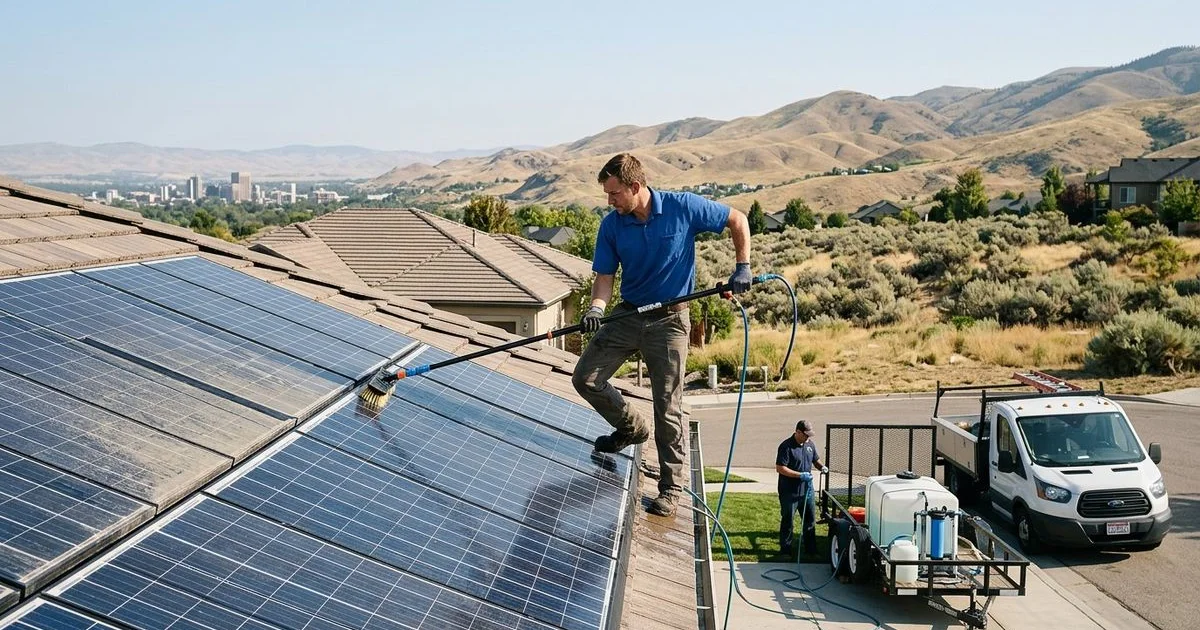
Industry research from the National Renewable Energy Laboratory confirms that soiled commercial panels in semi-arid climates can lose up to 15 to 20 percent of their energy output during peak dry periods. Our field technicians regularly measure these exact loss rates on unwashed arrays during late summer.
Using a conservative 20 percent loss figure on a 60-kilowatt system, the financial drain is obvious:
- Annual production loss: 17,000 to 19,000 kilowatt-hours
- Annual revenue loss: $1,520 to $1,900 per year
- Five-year cumulative loss: $7,600 to $9,500
We compare those losses directly to the cost of professional upkeep. A quarterly cleaning schedule for a 150-panel commercial system typically costs between $2,000 and $4,000 per year. Even at the higher end, the return on investment remains clear after accounting for warranty protection and asset longevity.
Hidden Costs of Neglecting Commercial Panel Maintenance
The raw production numbers only tell part of the story. Our experience shows that the full financial picture includes several secondary factors that make the case for maintenance even stronger.
Accelerated Panel Degradation
All solar panels degrade gradually over their lifespan, typically losing about 0.5 percent of their output per year according to National Renewable Energy Laboratory data. Our maintenance logs reveal that panels subjected to chronic soiling, corrosive bird droppings, and acidic wildfire residue degrade much faster. Poorly maintained equipment can degrade at double the baseline rate. On a commercial installation worth hundreds of thousands of dollars, this accelerated wear represents a massive loss of asset value.
Hot Spot Damage from Bird Droppings
Bird droppings on commercial panels create an immediate physical hazard. We see this often on flat warehouse roofs where pigeons gather. When a dropping covers a portion of a solar cell, that cell cannot generate electricity, forcing the current from adjacent cells through the blockage.
This bottleneck creates a hot spot that can reach temperatures exceeding 150 degrees Fahrenheit. Hot spots permanently damage the affected cells and can burn out the bypass diodes. Regular cleaning removes these blockages before they cause irreversible thermal damage.
Warranty Compliance
Most top-tier solar manufacturers require regular cleaning as a strict condition of coverage. Our review of the Canadian Solar Inc. warranty documentation shows they explicitly state that damages induced by inappropriate cleaning procedures or failure to remove bird droppings will void their coverage. Major brands like Qcells also mandate keeping modules clear of debris to maintain their 12-year product and 25-year performance warranties.
We strongly advise keeping detailed service records. If a panel fails and the manufacturer determines that inadequate maintenance contributed to the failure, your claim will likely be denied. Replacing an individual commercial panel costs $300 to $500 including labor.
- Keep service logs: Document the dates and methods of every wash.
- Use approved methods: High-pressure washers can damage seals and void coverage.
- Address shading fast: Remove bird waste immediately to prevent diode failure.
- Monitor alerts: Watch your inverter data for sudden string voltage drops.
Investor and Stakeholder Reporting
Businesses that financed their installation through power purchase agreements closely monitor their production data. Our clients with investor-backed financing know that declining production triggers covenant violations and concerned inquiries. Keeping panels clean ensures your production data matches the original financial projections.
The Compounding Effect of Regular Maintenance
One of the most powerful aspects of commercial array care is the compounding effect over time. Our data proves that clean panels do not just produce more today. They produce more every single day going forward because routine washing prevents the cumulative buildup that bakes into the glass.
We compiled a tracking model based on a typical 150-panel commercial system over a five-year period. The gap between maintained and unmaintained systems widens every year.
| Timeline | With Quarterly Cleaning | Without Cleaning |
|---|---|---|
| Year 1 | Produces 97 to 99 percent of rated capacity. | Drops to 75 to 85 percent of rated capacity. |
| Year 3 | Produces 95 to 98 percent after normal degradation. | Plummets to 65 to 75 percent as mineral deposits bond. |
| Year 5 | Maintains 93 to 97 percent of rated capacity. | Produces only 55 to 65 percent, with permanent hot spot damage. |
By year five, the cumulative production difference can easily exceed $10,000 in lost energy value. Our financial analysis shows this severe drop in efficiency destroys your expected returns. This loss is far more than the total cost of five years of quarterly service based on local pricing.
Industry-Specific Considerations in Idaho
The ideal approach depends entirely on your location and immediate surroundings. Our teams service diverse facilities across the state, and we see distinct patterns based on the local environment.
Warehouses and Distribution Centers
Large flat-roof installations common on Meridian and Nampa warehouses accumulate dust rapidly. Our technicians note that proximity to ground-level industrial activity and major highways like I-84 kicks up significant tire ash and exhaust particulate. These roofs also tend to be surrounded by large asphalt parking areas that generate reflected heat and dust upward.
Retail and Office Buildings
Commercial buildings in high-visibility locations like Eagle Road or downtown Boise benefit from clean solar arrays both economically and aesthetically. We remind property managers that dirty panels visible from the street send an unintended message about facility upkeep. A sparkling rooftop array reinforces a modern, efficient corporate image.
Agricultural and Rural Commercial
Businesses operating near active farmland face the most aggressive soiling conditions in the region. Our service maps show that Canyon County, which contains over 236,000 acres of prime farmland, generates massive amounts of fugitive dust. Tractors harvesting sugar beets and onions, combined with spring plowing, put heavy particulate matter into the air.
We measure efficiency drops of 30 percent or more between cleanings in these agricultural zones. Monthly or bi-monthly service during the dry harvest season is often the most cost-effective schedule for these rural facilities.
Common Treasure Valley localized hazards include:
- Fugitive dust from Canyon County agricultural plowing.
- Particulate matter from I-84 commercial traffic.
- Wildfire ash accumulation during late summer months.
- Mineral scaling from hard water sprinkler drift.
Building a Cleaning Schedule That Maximize ROI
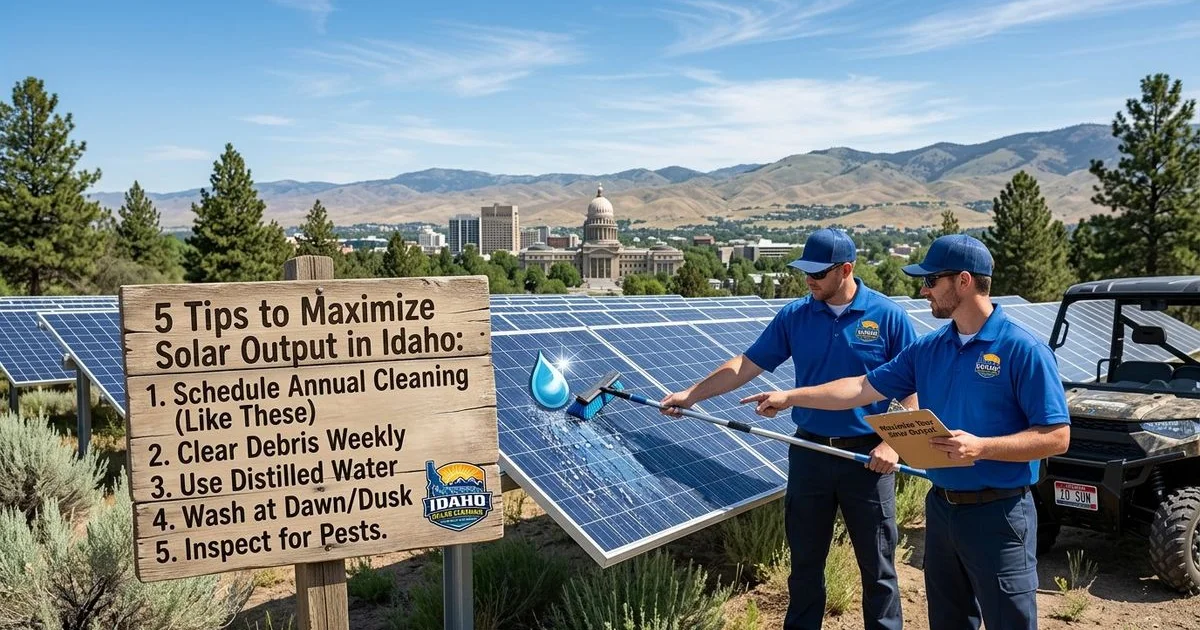
The optimal schedule for your commercial installation depends on your specific roof type and production goals. Our baseline recommendation for most Idaho commercial installations is a quarterly rotation that aligns with the changing seasons.
- Q1 (March): Post-winter sweep to remove snow residue, mineral deposits, and road salt.
- Q2 (June): Pre-summer detail to maximize production during the longest, highest-yield days of the year.
- Q3 (September): Post-smoke-season wash to remove wildfire particulate and heavy summer agricultural dust.
- Q4 (December): Pre-winter prep to optimize light capture during shorter fall and winter days.
This steady cadence ensures your system enters each season in peak condition. It guarantees your equipment never goes more than three months without a professional visual inspection.
Take the First Step Toward Better Returns
Every day your equipment operates below its rated capacity is a day your business leaves money on the table. We know the math supports proactive maintenance.
When analyzing commercial solar panel cleaning ROI, why Idaho businesses can benefit so clearly is tied directly to these recovered energy metrics. The choice requires a modest recurring investment that generates measurable returns.
Contact us to schedule a complimentary assessment of your commercial installation. Our technicians will measure your current soiling levels and provide a customized proposal.
A clean array is a profitable array.